
Foot and ankle pain is a common problem among our patients here in Brisbane. Some feel it as a sharp pain when they walk, a dull ache after exercise, stiffness in the morning, or even a twinge that doesn’t settle throughout the day. As your ankle supports your entire body weight throughout the day, even small issues can quickly become limiting and affect your comfort, stability, and quality of life.
Here at The Feet People, our practice takes a personalised, big-picture approach to understanding your foot and ankle pain. That means looking at the ankle joint itself, the surrounding ligaments and tendons, your foot biomechanics and gait, your activity levels, and anything in your lifestyle that may be contributing.
Ankle pain conditions we commonly treat
There can be several reasons your ankle may be hurting, and they don’t all feel the same. Some conditions cause sharp, localised pain, while others create stiffness, swelling, or deep aching that will worsen when you're active. While many cases of ankle discomfort are due to sports injuries, here are some other common ankle-related conditions our podiatry team sees and has specialised services for across our private practice clinics.
Stress fractures
Stress fractures are tiny cracks in the bone caused by repetitive overload. In the ankle region, they often occur in the tibia, fibula, or talus as these bones absorb significant impact when you walk, run, or jump. Symptoms typically start as mild, activity-related pain and can progress to constant discomfort if they're left ignored. People who rapidly increase their training and practice cessions, wear worn-out footwear, or have biomechanical factors like flat feet or high arches are more susceptible.
Achilles tendon pain
Your Achilles tendon connects your calf muscles (at the back of your leg) to the back of your heel, playing a crucial role in mobility. The Achilles plays a huge role in walking, running, and pushing off. Achilles tendinopathy occurs when the tendon becomes irritated or degenerates from overuse. While most people feel pain along the tendon itself, it frequently causes secondary ankle pain because the ankle joint has to compensate. You may notice morning stiffness, tightness through the back of the ankle, and pain that warms up with movement but aches afterwards. Achilles tendinopathy is one of the most common sports injuries we see.
Sever’s disease (heel pain in children and teens)
Sever’s disease is one of the most common causes of heel and ankle pain in children aged 8–14. It's an irritation at the growth plate at the back of the heel, where the Achilles tendon attaches. During growth spurts, bones can grow faster than muscles and tendons, creating excess tension through the heel and ankle. Kids often describe their symptoms as pain in the back of the heel or the sides of the ankle, especially after sports, running, or jumping. While some people think you just have to wait it out and skip sports practice, Sever’s is treatable.
Pregnancy-related ankle pain
During pregnancy, hormonal changes increase ligament laxity, while fluid retention and rapid shifts in weight distribution place extra demand on the ankles. As your centre of gravity changes, your feet may roll in more than usual (increased pronation), which can strain the ankle joints, tendons, and the surrounding structures. This often results in aching, stiffness, swelling, or a feeling of instability around the ankle. Even women with no prior foot or ankle problems can experience discomfort during pregnancy simply because of the mechanical changes in the body.
Osteoarthritis
Osteoarthritis occurs when the cartilage that cushions the ankle joint wears down over time. This can happen after previous injuries (particularly ankle sprains), long-term overloading, or simply age-related changes. People with ankle osteoarthritis often describe deep aching, stiffness, swelling, or pain that appears after activity rather than during it. As the ankle joint absorbs force with every step, even mild arthritic changes can make walking difficult and cause compensatory pain in nearby areas, such as the foot or lower leg. Other forms of arthritis, such as post traumatic arthritis, can also develop.
Ankle sprains
Ankle sprains occur when the ligaments around the joint are stretched or torn. This happens most often when the foot rolls inwards while the ankle joint rolls outwards - we see this often in sports injuries. While many people treat sprains as minor injuries, they can lead to ongoing ankle pain, swelling, weakness, or instability if not rehabilitated properly.

Brisbane clinic locations & opening hours
We treat foot and ankle pain at both of our convenient Brisbane locations — in the CBD and Newmarket, in Queensland. Find clinic details and opening hours below:
Brisbane CBD clinic information (Queensland)
-
Mobile: 0483932145
Phone: (07) 3356 3579
Fax: (07) 3220 3851
Address: Ground Floor/344 Queen Street, Brisbane QLD 4000 -
Operating Hours:
Monday: 7:40am – 6:30pm
Tuesday: 7:40am – 6:00pm
Wednesday: 7:40am – 6:30pm
Thursday: 7:40am – 6:00pm
Friday: Temp Closed
Saturday: Closed
Sunday: Closed
Newmarket clinic information
-
Mobile: 0483932146
Phone: (07) 3356 3579
Fax: (07) 3220 3851
Address: Shop 114, Newmarket Village, 400 Newmarket Road, Newmarket QLD 4051 -
Operating Hours:
Monday: 7:40am – 6:00pm Tuesday: 7:40am – 6:00pm Wednesday: 7:40am – 6:00pm Thursday: 7:40am – 6:30pm Friday: 7:40am – 5:00pm Saturday: 7:40am – 4:30pm Sunday: Closed
How we diagnose, assess and treat ankle pain
When you come in, we begin by understanding when the pain started, what movements make it worse, whether there was an injury, and how it affects your daily activities. From there, we examine the ankle joint itself: checking for swelling, tenderness, ligament integrity, joint movement, and muscle strength. We also look beyond the ankle. Issues higher up the leg can all influence how much load your ankle is taking.
Treatment options for ankle pain
Because ankle pain can come from many different sources, such as from overuse or sports injuries, the treatment focus varies from person to
person. Some of the treatment options and services we commonly use include:
For a full list of services we offer, please see the 'services' tab on our website.
Why do we recommend early treatment of ankle pain?
The ankle is a busy, weight-bearing joint, and leaving pain to “see if it settles” can often lead to bigger problems. Minor sprains can turn into chronic instability. Mild tendon irritation can develop into long-term tendinopathy. Small biomechanical issues can overload other parts of the foot and leg, causing a chain reaction of discomfort. And in growing children or active adults, pushing through pain often leads to longer recovery times.
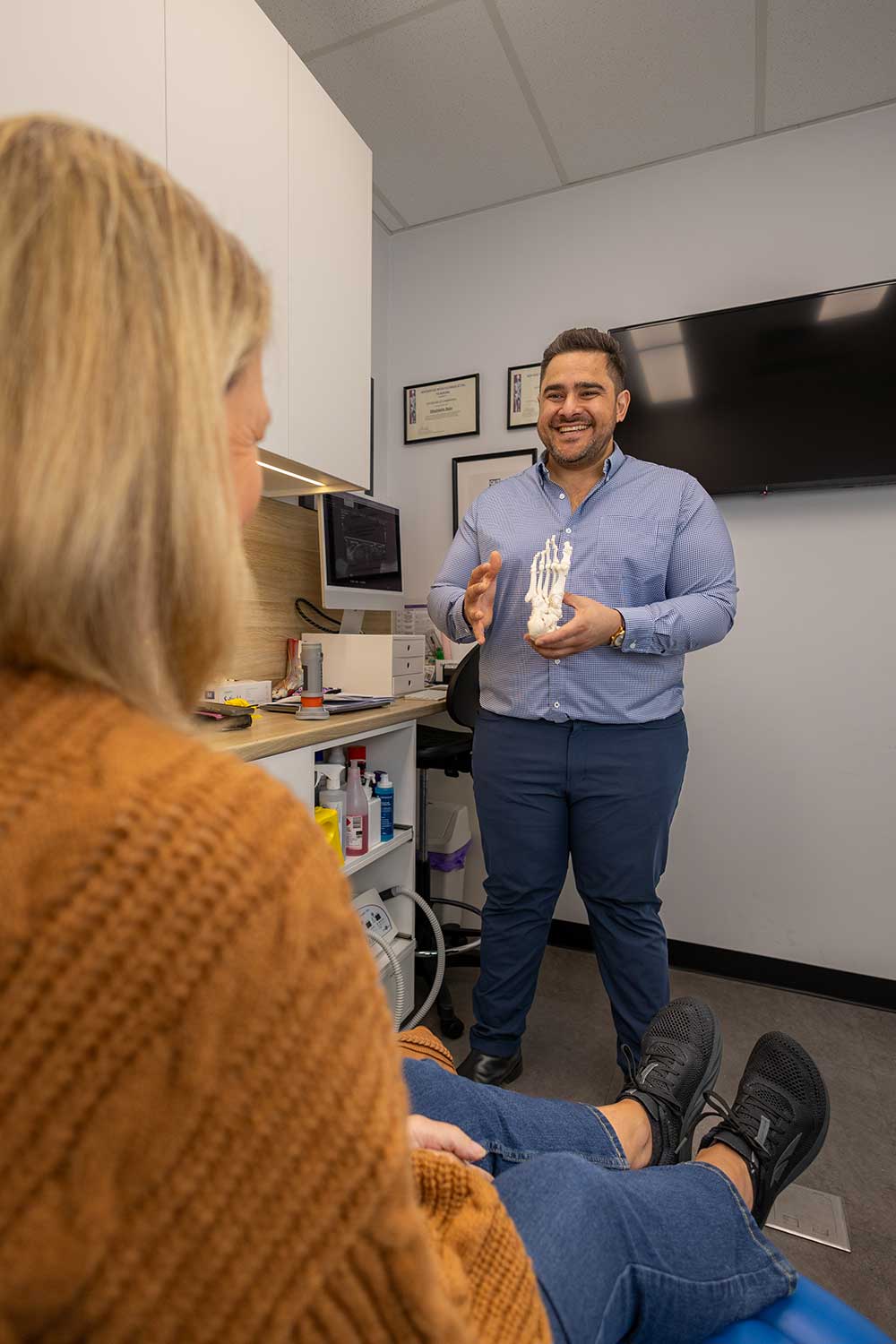
Book an appointment with an ankle specialist in Brisbane
If foot and ankle pain is stopping you from moving comfortably, keeping you from the activities you love, or simply not improving on its own, we’re here to help. Our podiatry team focuses in diagnosing and treating foot and ankle conditions, and we take the time to understand your unique situation so you get the right care from the start.
You don’t have to keep pushing through pain or hoping it will fade on its own. Book an appointment with a foot and ankle specialist in Brisbane and let’s get you back to walking confidently, moving freely, and feeling better with every step. We're proud to be one of the industry leaders in Australia.
FAQs
Do podiatrists treat ankle injuries?
Yes, this is a major focus in podiatry. Podiatrists are highly trained in diagnosing and treating foot and ankle conditions, and work with the entire lower limb, including the ankle, Achilles tendon, calf muscles, and surrounding structures of the foot. We assess sprains, strains, tendon issues, persistent swelling, instability, and pain caused by biomechanical overload. As we look closely at how your foot and leg function together, we can identify the underlying cause of the injury and provide personalised treatment, rehabilitation, and prevention strategies.
When should I see an ankle specialist?
You should see a foot and ankle specialist if your pain isn’t improving, keeps returning, affects your daily activities, or came on after an injury such as a twist or fall. Other signs include swelling that doesn’t settle, difficulty walking or bearing weight, a sense of instability, or pain that worsens with movement. If your ankle feels stiff in the morning, aches after exercise, or you’re adjusting how you walk to avoid discomfort, it’s a good time to be assessed.
Do I need a referral to see a podiatrist?
No, you don’t need a referral to see a podiatrist. You can book directly whenever you need support with ankle pain, foot issues, or lower-limb concerns to have your assessment completed.
What’s the difference between a podiatrist and an orthopaedic surgeon?
Podiatrists and orthopaedic surgeons both treat foot and ankle conditions, but their roles are different. Podiatrists specialise in treating patients struggling with foot and ankle conditions or injuries (including sports injuries) through conservative (non-surgical) treatments such as rehabilitation, biomechanical correction, orthotics, footwear recommendations, and manual therapies.
Orthopaedic surgeons hold a medical degree and have completed orthopaedic training at a medical university in Australia, or abroad. They are trained to perform foot and ankle surgery (among other areas of trauma) when structural damage is severe or when conservative care isn’t enough. This includes minimally invasive surgery, ankle fusion, arthroscopy, bunion correction (and keyhole bunion surgery), ankle replacement and other arthroscopic techniques. Most foot and ankle conditions and injuries don't involve reconstructive surgery and can be successfully treated by a podiatrist without surgery, and we can refer you to a surgeon if your condition requires surgical assessment.
Alongside surgeons, we also work closely with physiotherapy teams. Our physiotherapy partners may be involved to look at the effects of the upper body, hips and core on ankle function, ensuring nothing important is missed. By combining podiatry with physiotherapy, we can address both the mechanics of the foot and the strength and movement patterns higher up the chain, giving you a more complete and effective treatment plan. We will refer you for physiotherapy if needed.
Where can I find more info on foot and ankle conditions, ankle disorders or ankle sprains?
Our website contains a range of information on ankle injuries and foot injuries resulting from trauma, arthritis, sports injuries, the ageing process and more. We have a strong focus on minimally invasive treatment and preventative medicine to help our patients learn as much as they can about the foot related challenges they may be facing, and our personalised care approach to foot care.
For information on foot and ankle surgery, total ankle replacement, arthritis surgery, bunion correction or more surgical information, we recommend visiting the Royal Australasian College of Surgeons or the Australian Orthopaedic Association, to be guided by their helpful resources.