
If the outside of your hip hurts when you walk, climb stairs, exercise or lie on your side, an irritated bursa is one possible cause. Our Brisbane podiatrists can assess where your hip pain symptoms are coming from, explain what may be irritating the area, and help you plan your next steps.
Hip bursitis describes the irritation or inflammation of a small, fluid-filled sac called a bursa. We have bursae throughout the body. They act like small cushions between bones and soft tissues, helping muscles and tendons glide over the bone with less rubbing. Around the hip, these fluid-filled sacs help reduce friction as you walk.
The most common type of hip bursitis is called trochanteric bursitis. It affects a bursa that sits near a spot called the "greater trochanter", which is the bony prominence on the outside of the upper thigh. If you run your hand down your outer hip region and feel a firm bump, that is the general area.
However, soreness at the side of the hip is not always caused by a swollen bursa alone, or at all. The nearby gluteal tendons, which join the buttock muscles to the hip bone, may also be irritated. The iliotibial band, a strong band of tissue that runs down the outer thigh, can be involved too. For your reference, doctors and health professionals often use the broader name greater trochanteric pain syndrome when one or more of these structures may be causing a persons symptoms.
Here at The Feet People in Brisbane, we look at your symptoms, strength, hip joint movement and the way your whole lower limb moves, before we give a diagnosis. We then develop a treatment plan that addresses your symptoms, the cause, your daily activities, and the kind of movement you want to get back to doing.
What Does Hip Bursitis Feel Like?
Hip bursitis usually causes pain and tenderness at the side of the hip (hip pain) rather than deep inside the joint or groin. The pain may radiate a short distance down the outer thigh. It is often more noticeable when direct pressure is placed on the affected side.
You may notice pain when:
- lying or sleeping on the affected side
- walking or running for longer than usual
- climbing up the stairs
- balancing or standing on one leg
- getting up from a low chair
- increasing your exercise or training
- pressing over the outside of the upper thigh
For some people, they will feel a dull ache. Others notice sharper discomfort during certain movements. The area may also feel stiff or sore at night, particularly when lying on it.
Several hip injuries and medical conditions can cause similar symptoms. Seek urgent medical assessment if the symptoms follow a significant fall or injury and you cannot put weight through the leg. You should also seek prompt care if you develop sudden severe pain with a hot, red or swollen joint, fever, or feel acutely unwell.
Common Causes of Hip Pain from Bursitis
Hip bursitis often develops when the bursa and nearby soft tissues are repeatedly pressed on or are forced to handle more activity than they are ready for. We call this 'overloading'. There is not always one clear cause and several factors may be involved.
Common causes and contributing factors include:
- A sudden increase in activity: increasing your running distance, hill walking, cycling, stair climbing or gym training too quickly can irritate the hip bursa and nearby tendons.
- Repetitive movements: sport, work or exercise that involves the same lower-limb action many times can irritate the area. Activities that require repetitive motion are more likely to cause trouble when there has been a sudden change in how often, how hard or how long you do them.
- Reduced strength around the pelvis: the gluteal muscles help keep the pelvis level when you walk, run or stand on one leg. If these muscles are not strong enough for the demands placed on them, the tissues at the side of the hip may have to work harder.
- Changes in the way you walk or run: the feet, ankles, knees and hips work as a chain. A change in one area can alter how force travels through the hip region. This does not mean every case starts at the feet, but lower limb movement can be relevant for some people.
- Pressure on the side of the body: sleeping on the affected side, crossing your legs or regularly resting most of your weight on the same leg can compress the bursa and gluteal tendons.
- Prolonged standing: long periods on your feet, particularly if you lean more heavily on one side, may exacerbate symptoms, making the pain worse.
- Irritation around the iliotibial band: the iliotibial band is a strong band of tissue that passes over the outside of the upper thigh and can add pressure to the outer hip region if it is damaged or irritated.
- A fall or direct blow: landing on your side can irritate the bursa and other soft tissues.
- Other joint or medical conditions: osteoarthritis and rheumatoid arthritis may contribute to pain around the hip. Rheumatoid arthritis can also increase the risk of bursitis in other parts of the body.
- A previous lower-limb injury: a foot, ankle, knee or other injury may temporarily change the way you walk, placing different demands higher up the leg.
It can affect people of different ages and activity levels. Trochanteric bursitis and related conditions are more common in middle-aged and older women, but they can also affect younger people and athletes.
Brisbane Clinic Locations & Opening Hours
We provide hip bursitis treatment at both of our convenient Brisbane locations - in the CBD and Newmarket. Find clinic details and opening hours below:
Brisbane CBD clinic information
-
Mobile: 0483932145
Phone: (07) 3356 3579
Fax: (07) 3220 3851
Address: Ground Floor/344 Queen Street, Brisbane QLD 4000 -
Operating Hours:
Monday: 7:40am – 6:30pm
Tuesday: 7:40am – 6:00pm
Wednesday: 7:40am – 6:30pm
Thursday: 7:40am – 6:00pm
Friday: Temp Closed
Saturday: Closed
Sunday: Closed
Newmarket clinic information
-
Mobile: 0483932146
Phone: (07) 3356 3579
Fax: (07) 3220 3851
Address: Shop 114, Newmarket Village, 400 Newmarket Road, Newmarket QLD 4051 -
Operating Hours:
Monday: 7:40am – 6:00pm Tuesday: 7:40am – 6:00pm Wednesday: 7:40am – 6:00pm Thursday: 7:40am – 6:30pm Friday: 7:40am – 5:00pm Saturday: 7:40am – 4:30pm Sunday: Closed
How We Diagnose, Assess and Treat Hip Bursitis
The first step is to diagnose the cause of your hip pain, as there are several potential causes that can produce similar symptoms around the outer hip. Trochanteric bursitis can feel similar to irritation of the gluteal tendons, iliotibial band problems, osteoarthritis, pain referred from the lower back and other hip injuries. Sometimes more than one structure is involved.
At your appointment, your podiatrist will ask where you feel the symptoms, when they started and which activities make them better or worse. We will also ask about changes to your exercise or work, previous injuries, footwear, general health and relevant medical conditions.
Your physical examination may include:
- gently pressing around the outside of the pelvis to locate the tender area
- checking how far and how comfortably the hip joint moves
- testing the strength of the muscles around your pelvis
- watching how well you control the pelvis during a single-leg balance test
- checking foot posture and the alignment of the lower limb
- watching how you walk or run
- using video gait analysis or in-shoe pressure analysis when it may add useful information
These checks help us understand whether the bursa is likely to be irritated and whether weakness, movement or a recent increase in activity may be contributing. Joint mobility simply means how freely a joint can move. Gait is the clinical term for the way you walk.
Imaging is not needed for every case. If the cause of your hip pain is unclear, we may refer you for an ultrasound to examine the area in detail and confirm your diagnosis.
If we suspect that your symptoms are actually from referred pain from further up the body, such as from the lower back, we'll refer you to the right specialist or your GP accordingly.
Our aim here is not simply to give the problem a name. It is to help you understand what is going on, why it has happened, and give you an evidence-based plan for what you can do to move comfortably again.
Hip Bursitis Treatment
Your treatment plan depends on what your assessment finds, how long you have had symptoms and what is placing pressure on the area. Your treatment plan may include several of the following approaches.
Activity and Load Modification
Your load is the amount of work you ask your body to do. It includes how often, how hard and how long you walk, run, exercise or perform physical work.
Reducing this load for a short time can help settle the irritated area without necessarily requiring you to stop all activity (this is case dependent). For example, you may temporarily shorten your walks, reduce hill running, use fewer stairs or alternate a repetitive task with something less demanding. We aim to keep you moving safely where possible, then help you build your activity back up as the area becomes more comfortable and capable.
Strengthening and Rehabilitation Exercises
Strengthening is often an important part of treatment, particularly when the gluteal tendons or muscles are involved and may be weakened or imbalanced. The aim is to make the muscles around the pelvis better able to support you during walking, climbing stairs, running and other daily activities.
We usually begin with exercises that the sore area can tolerate and make them gradually more challenging. This is what progressive strengthening means. It may improve comfort now and lower the chance of another flare-up by improving how much work the tissues can handle. This gradual approach can also promote healing without repeatedly irritating the area.
Gait Assessment and Gait Retraining
Gait retraining means making small, purposeful changes to the way you walk or run. If your assessment shows that a particular movement is adding stress to the affected area, we may suggest changes to your stride, step rate, training routine or technique.
These changes are individual. The goal is not to create one “perfect” way of moving, but to reduce stress on the painful area while it recovers.
Footwear Advice and Custom Foot Orthotics
Your feet are the base of your lower limbs. In some people, foot posture or movement changes how pressure travels through the leg and all the way up to the hip.
If this is relevant to your symptoms, we may recommend a different type of shoe or certain changes to when you wear particular footwear. Custom orthotics are specialised shoe inserts made for your feet. They are often used to change how forces move through the legs, with the goal being to reduce stress higher up the leg. We only recommend foot orthotics them when your assessment gives us a clear reason to do so.
Shockwave Therapy
Shockwave therapy uses a handheld device to send controlled sound waves into the target area. Don't worry - despite the name, it does not deliver any electric shocks. You may feel tapping or pressure against the skin during treatment.
It may be considered for some persistent cases of bursitis or greater trochanteric pain syndrome, particularly when a nearby tendon is involved. Shockwave therapy is non-invasive and can help stimulate circulation and tissue regeneration as part of a comprehensive treatment plan.
MLS Laser Therapy
MLS laser therapy is a non-invasive treatment that directs specific wavelengths of light into the painful area through the skin. There are no needles or incisions, and most people feel little or nothing while the laser is being applied, aside from the occasional warming effect.
The treatment is intended to affect how cells in the targeted tissues respond, with the aim of helping to relieve pain and reduce inflammation. Your podiatrist may consider it when short-term symptom relief would help you move more comfortably and forms one component of a comprehensive treatment plan.
Dry Needling and Manual Therapy
Muscles around a painful hip can become tight or guarded. This means they tense up to protect the area, sometimes adding to discomfort or making movement feel restricted.
Dry needling, soft-tissue techniques or other manual therapies may be used to help ease this muscle tension and make movement more comfortable. The hands-on part may involve working on tight muscles or helping a stiff area move.
Referral for Other Treatments When Needed
Hip bursitis often involves a multi-disciplinary approach to help you get the best results. Your GP or specialist may discuss anti-inflammatory medication if it is safe and suitable for you. A corticosteroid injection may be considered in some cases to ease symptoms for a period, although it does not correct the strength or loading factors that may be contributing.
Surgery is uncommon and is generally only considered for persistent cases that have not improved with appropriate non-surgical care. If your symptoms need further investigation or other treatments outside our scope, we will explain why and refer you to the appropriate health professional.
Why Do We Recommend Early Treatment of Hip Bursitis?
Mild symptoms can settle when the aggravating activity is adjusted. However, ongoing discomfort can lead you to change the way you move without realising it. You may take shorter steps, shift your weight away from the affected side or stop activities that normally keep you strong.
Over time, these changes can place more work on other parts of the body and make it harder to return to normal activity. An early assessment can help you understand what is happening before these habits become established.
Early care can help to:
- check whether the problem is likely to be trochanteric bursitis or another condition
- identify the movements or activities that exacerbate symptoms
- reduce pain without unnecessarily avoiding all activity
- rebuild strength around the pelvis and lower limb
- address relevant foot and leg movement patterns
- plan a gradual return to work, walking, exercise or sport
- reduce the chance of repeated flare-ups
- prevent your pain or systems from getting worse
Early treatment does not always mean having more treatment. Often, it means getting clear advice sooner, so you know what to change, what you can safely continue and how to help the area recover.
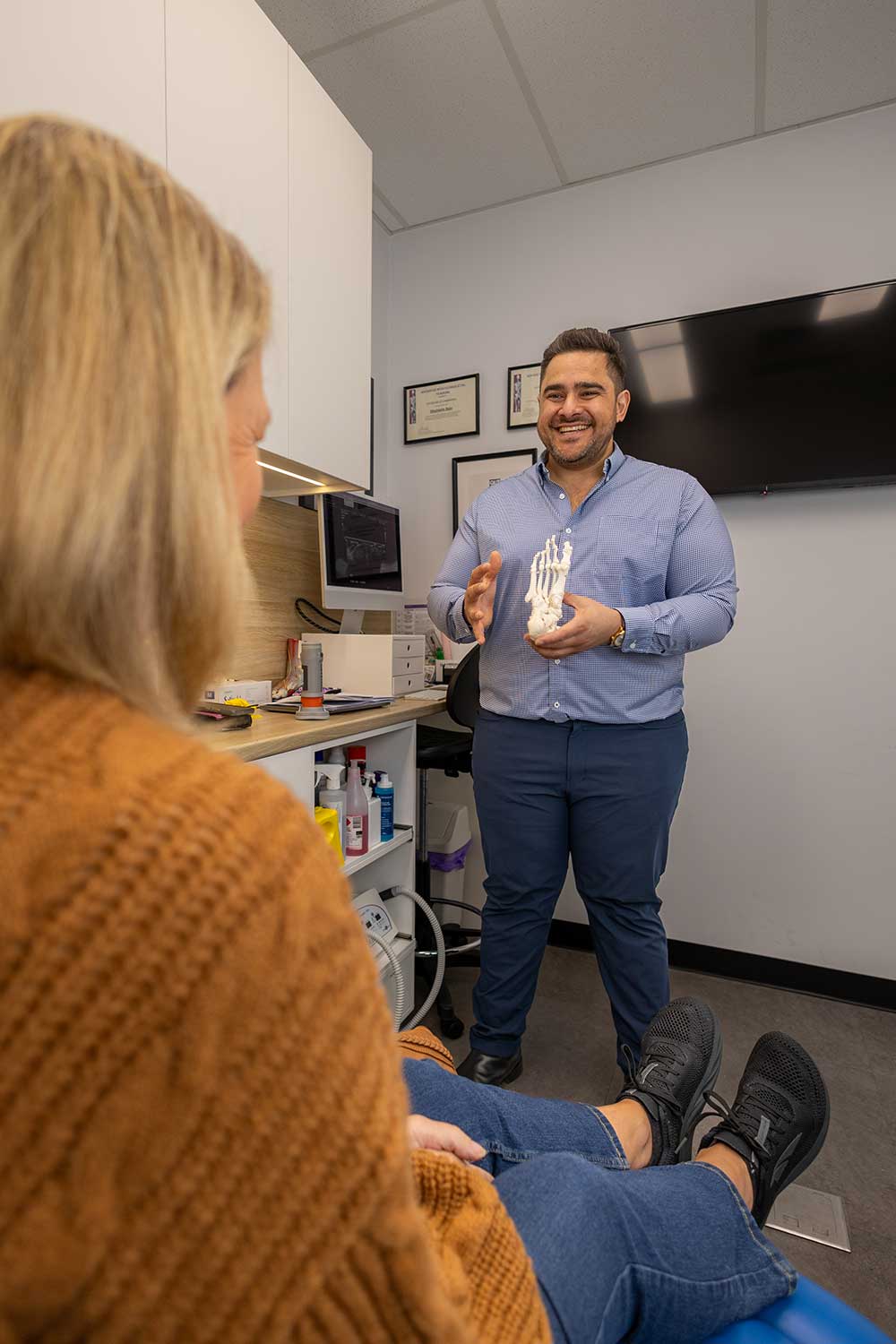
Book an Appointment to Get Hip Bursitis Treatment in Brisbane
If symptoms around the outside of your hip are affecting sleep, walking, exercise or day-to-day activities, our podiatrists can help you work out what is causing them and what to do next. Here at The Feet People, we assess the hip joint, lower limb, feet and the way you move, then build a treatment plan around your diagnosis, lifestyle and goals. We provide hip bursitis treatment in Brisbane from our CBD and Newmarket clinics. You do not need a referral to book an appointment.
FAQs
What Causes Hip Bursitis to Flare Up?
A flare-up often happens when the tissues at the side of the pelvis are suddenly asked to do more work, or cope with more pressure, than they can safely handle. This may follow a longer-than-usual walk, more running, repeated climbing stairs, hill training, prolonged standing or sleeping on the affected side.
A flare-up does not always mean that you have caused new damage. It may simply be a sign that the activity was too much for the area at that point in your recovery. Temporarily adjusting the activity can allow symptoms to settle while you continue to build strength.
How Long Does Hip Bursitis Take to Heal?
There is no single recovery time - our podiatrists assess this on a case by case basis and let you know at your appointment.
Your recovery time will depend on which tissues are painful, how long you have had symptoms, your general health, your daily demands and how steadily you can complete rehabilitation. Progress is not always a perfectly straight line. A temporary flare-up can happen even when the overall trend is improving.
If the symptoms are not improving, become more severe or keep returning, another assessment can check whether the original diagnosis and treatment plan still fit.
Can Orthotics Help with Hip Bursitis?
Orthotics can help when foot posture, gait or lower-limb mechanics are contributing to uneven loading through the leg, leading to overloading the hip and bursa. In these situations, custom orthotics can form one part of a broader plan alongside strengthening and activity modification. The best way to know whether orthotics are relevant is through a biomechanical and gait assessment.
What Exercises Should I Avoid with Hip Bursitis?
If an exercise you're doing causes a clear increase in pain during the activity or leaves you noticeably more sore afterwards, then it's important to avoid it until you can see your podiatrist.
During a flare-up, high-volume stair climbing, hill running or exercises that repeatedly place most of your weight on the affected leg are more likely to feel uncomfortable. This does not usually mean avoiding exercise completely. We can help you change the range, resistance, repetitions or frequency so you can keep moving while the area settles.
Is Hip Bursitis Permanent?
Hip bursitis is not automatically permanent.
When symptoms keep returning, it may mean the area is still being asked to do more than it can handle. It can also mean that a nearby gluteal tendon, rather than only the trochanteric bursa, is contributing. In this case, looking at your muscle strength, recent activity and the way you move can help identify why the problem keeps returning and what may need to change.
What Does "Trochanteric Bursitis" Mean?
Trochanteric bursitis simply means irritation or inflammation of the small, fluid-filled sac that cushions the bony point on the outside of the hip.
Will I Need Surgery?
Most cases of hip bursitis do not require surgery, but your podiatrist will be able to advise you based on your unique circumstances at your appointment. Surgical treatment for hip bursitis may involve arthroscopic methods to remove the inflamed bursa and decompress the iliotibial band.