
If you're experiencing pain in one spot in your foot or lower leg that gets worse when you walk, run or jump, there is a chance that you may have developed a stress fracture. Our podiatrists are highly experienced in helping manage stress fractures in athletes, working professionals and cases that seem to present "out of nowhere". Here's what you need to know about how stress fractures behave.
Stress fractures often start as a mild ache when you're on your feet. If the damaged bone keeps being loaded (you keep putting weight or pressure on it), the pain may continue on and even worsen when you're resting, instead of subsiding and feeling better.
A stress fracture is not a single clearly visible crack like in regular "broken bone" fractures. We refer to stress fractures as a "bony stress reaction", meaning that over time the bone starts to buckle in an area that's regularly overloaded.. This results in micro-cracks that resemble the roots of a tree. If nothing changes and the loading continues, the micro-cracks can worsen, and may eventually lead to significant pain and discomfort. Stress fractures fall into a group called "overuse injuries", which means they're directly related to how you're using your feet and legs. They also affect a range of different bones in the feet and legs.
Here at The Feet People, our Brisbane podiatrists assess your feet and legs to determine whether you do have a stress fracture - or if your symptoms are indicating a different problem. In order to diagnose the problem and create a management plan, we look at the painful area, your recent activity, your general health and the way you move. If imaging tests are needed, we can refer you and arrange the best next step. Your treatment plan will depend on which bone is affected and how serious the injury appears to be.
What Are Stress Fractures?
Bones are living tissue. Every day, your body removes small areas of older bone and replaces them with new bone. Exercise helps bones become stronger, but they need enough time, energy and nutrients to make those repairs.
Stress fractures occur when repeated load (overuse) causes damage to a bone faster than the body can repair it. This can happen after a sudden increase in running or sport, which we often see in those who are active, but are definitely not the only people affected. A new walking programme, a holiday with much more walking than usual or long hours on your feet can also be enough to overload a bone.
If the bone is already weaker because of osteoporosis, low bone density, illness, medication or poor nutrition, a stress fracture may occur with ordinary activity. This is sometimes called an insufficiency fracture and will promptly require treatment.
Symptoms of Stress Fractures in the Foot and Lower Leg
The pain from a stress fracture usually builds gradually rather than beginning with one obvious accident. Stress fractures are different from broken bones that typically have "clean" cracks through them that are sharply painful, and tend more to produce vaguely located pain. Common symptoms include:
- pain (localised tenderness) in a specific area of the foot, ankle or lower leg. This is the most reliable feature of a stress fracture.
- pain that becomes worse with walking, running, hopping or jumping
- tenderness when you press directly over one part of a bone
- swelling around the painful area
- pain that settles with rest but returns when the bone is loaded again
- pain that starts earlier during exercise as the injury progresses
- limping or changing the way you walk to avoid the sore area
- intense pain as the injury progresses
In a more advanced injury, normal walking may hurt and pain can continue at rest or at night. Please note that these symptoms can also be seen in other tendon, joint and related, so a proper assessment and diagnosis by your podiatrist is still important. A complete physical exam that includes a detailed description of your medical and exercise history is the best way to work out what is causing your pain, and get you on the right treatment plan.
What Should I Do if I Think I Have a Stress Fracture?
Stop running, jumping and any other activity that brings on the pain. Do not keep testing the area by repeatedly hopping on it. The goal will be to rest and support bone healing. Remember, as stress fractures can have many potential contributing factors, wear a supportive shoe and limit painful walking until you can be assessed.
Seek urgent medical care if:
- you cannot put any weight through the foot or leg
- the pain followed a fall, collision or other significant injury
- the foot or leg looks misshapen
- the area is very swollen, numb, cold or changing colour
- you have severe pain in the foot, hip or groin
- you have pain with fever, redness or feel unwell
- pain relievers are not working to relieve painful symptoms
How Do Stress Fractures Occur?
A bone stress injury usually develops when the load placed on the bone, its ability to recover, and the person's bone health become out of balance. It is often seen with increased weight bearing activity by a person (spending more time on their feet at greater intensities).
For example, a runner may add extra distance, speed sessions and hills at the same time. Their fitness may feel ready for the change, but their bones may not have had enough time to adapt. Another person may not have changed their activity at all, but a change in bone strength or nutrition can make their usual load harder to tolerate. The common link is an increase in physical activity.
Risk Factors for Stress Fractures
Factors that may increase the chance of a bone stress injury include:
- a rapid increase in your training volume, meaning more running, jumping, dancing, marching or walking (physical activity)
- returning to training too quickly after illness, injury or a long break
- doing the same high-impact activity on many consecutive days
- a change in training surface, footwear or sporting position
- foot shape or movement patterns that concentrate load on one area
- reduced muscle strength or endurance
- a previous stress fracture
- not eating enough to meet the energy demands of training and daily life
- low calcium or vit D, when confirmed through an appropriate health assessment
- irregular or absent periods
- low testosterone or other hormonal concerns
- osteoporosis or low bone density
- some medical conditions and long-term medicines that affect bone health
- smoking
Low energy availability means the body does not receive enough energy for exercise as well as basic jobs such as maintaining hormones, muscles and bones. It can affect people of any gender and does not always involve an eating disorder. In sport, the wider health problem is known as relative energy deficiency in sport, or RED-S.
Menopause can also affect bone health because lower oestrogen levels can speed up bone loss. Menopause itself does not mean that foot pain is a stress fracture, but it is one reason to consider bone density and wider health when symptoms develop with little change in activity.
If a fracture occurs during normal daily activity, keeps recurring or has no clear explanation, we may recommend a review with your GP. This may include blood tests, a bone density scan or support from a sports dietitian, endocrinologist or other health professional.
As stress fractures can lead to avascular necrosis, self diagnosing the problem is not recommended. Many athletes will miss identifying this problem and will continue with their regular physical activity, which can worsen the problem very quickly (while lengthening their recovery time).
Where Do Stress Fractures Occur?
The feet and lower legs absorb repeated force whenever we walk, run and jump. Any bony area can develop a stress fracture. Common sites include:
- the metatarsals, which are the long bones behind the toes
- the calcaneus, or heel bone
- the tibia, or shin bone
- the fibula, which is the smaller bone on the outside of the lower leg
- the navicular, a bone near the top of the arch
- the sesamoids, which are two small bones beneath the big toe joint
The second and third metatarsals are common sites because they take substantial load as the foot pushes away from the ground.
Not All Stress Fractures Are the Same
The exact location matters. Many bone stress injuries are described as low risk because they usually heal well when they are identified and protected. Others are high risk because the bone has a poorer blood supply or the forces acting on it make healing less predictable.
High-risk sites include the navicular, the base of the fifth metatarsal on the outside of the foot and the front edge of the tibia. Stress fractures at the hip are also high risk, although they sit outside the foot and lower-leg focus of podiatry care.
A high-risk injury may need strict protection from weight-bearing, repeat imaging and early review by a sports medicine doctor or orthopaedic surgeon. This is why treatment should not be based only on how painful the injury feels.
Common Causes of Stress Fractures
Stress fractures happen when a bone experiences repeated stress that outpaces its ability to heal. Rather than stemming from a single significant injury, these fractures are weakness areas in bone that form over time due to continuous pressure, often over several days or weeks. A variety of factors can lead to stress fractures, and it's common for individuals to face multiple contributing elements simultaneously.
Performing repetitive high-impact tasks usually causes stress fractures, with examples including distance running, basketball, and netball, among others, where you put constant impact on the same bones, especially those found in the lower parts of the leg.
Suddenly ramping up training intensity or volume. Bones require time to adapt, so increasing your workout too quickly can overwhelm their ability to cope with the new demands.
Footwear also plays a crucial role. Worn-out shoes or those ill-suited to your foot shape can add extra strain with each step.
The structure of your foot matters as well. Whether you have flat feet or high arches, the way your foot loads and pushes off can shift stress to specific areas, increasing the risk of injury.
Women in the menopause transition from perimenopause, menopause, and postmenopause are at risk due to a sharp decline in esterogen that triggers a widespread change in the musculoskeletal system which includes bones, muscles, joints and tendons.
For those with osteoporosis or low bone density, the risk of fractures is higher. Weaker bones can break under stress that healthy bones would withstand, which is of particular concern for women in the menopause transition, older adults or those with a history of bone density issues.
Nutrition is key. Adequate intake of nutrients like calcium and vit D supports bone repair. Without sufficient nutrition or if you're deficient in vit D, the healing process can slow down significantly.
Female athletes are at risk of developing stress fractures due to The Femail Athlete Triad that is a medical condition defined by low evergy availability (with or without eating disorders), menstal dysfunction (such as missed periods), and decreased bone mineral density (osteopenia or osteoporosis. This is most commonly seen in physical active women and competative athletes.
Brisbane Clinic Locations & Opening Hours
We provide stress fracture treatment at both of our Brisbane locations, in the CBD and Newmarket. Find clinic details and opening hours below.
Brisbane CBD clinic information
-
Mobile: 0483932145
Phone: (07) 3356 3579
Fax: (07) 3220 3851
Address: Ground Floor/344 Queen Street, Brisbane QLD 4000 -
Operating Hours:
Monday: 7:40am – 6:30pm
Tuesday: 7:40am – 6:00pm
Wednesday: 7:40am – 6:30pm
Thursday: 7:40am – 6:00pm
Friday: Temp Closed
Saturday: Closed
Sunday: Closed
Newmarket clinic information
-
Mobile: 0483932146
Phone: (07) 3356 3579
Fax: (07) 3220 3851
Address: Shop 114, Newmarket Village, 400 Newmarket Road, Newmarket QLD 4051 -
Operating Hours:
Monday: 7:40am – 6:00pm Tuesday: 7:40am – 6:00pm Wednesday: 7:40am – 6:00pm Thursday: 7:40am – 6:30pm Friday: 7:40am – 5:00pm Saturday: 7:40am – 4:30pm Sunday: Closed
How We Diagnose, Assess and Treat Stress Fractures
To diagnose a stress fracture, we perform a comprehensive physical assessment as well as obtain your medical history and a clear understanding of what has changed and examining the painful area.
Your podiatrist may ask about:
- where the pain is and when you first noticed it
- recent changes in training, work, walking or footwear
- previous bone stress injuries or fractures
- the amount of rest between activity sessions
- your general health, medicines and injury history
- nutrition and whether you are eating enough for your activity level
- anything you have noticed that has helped relieve pain
During the physical examination, we look for swelling and tenderness over the bone. We may assess your walking, foot posture, joint movement, strength and how the leg responds to gentle loading. We will not use a painful hop test simply to prove that the area hurts.
This assessment helps us decide how likely a bone injury is, whether the area needs immediate protection and which imaging or referral pathway is appropriate.
Why Stress Fractures May Not Show on Early X-Rays
X-rays are often the first scan used to look for a fracture, but a new bone stress injury may be too small to see. Changes can become visible several weeks later as the bone begins to repair itself. A normal early X-ray therefore does not always rule out a stress fracture.
We will explain whether you need imaging and help arrange referral where required. Importantly, the damaged bone may need to be protected while you are waiting for a scan.
Stress Fracture Treatment Options We Provide
Your treatment plan is based on the injured bone, the stage of the injury, your pain with walking, your bone health and the activity you want to return to. The plan may include several of the following steps.
Protecting the Injured Bone
The first aim is to stop the injury from getting worse. This usually means pausing running, jumping and other activities that cause pain, meaning that some people may need to reduce to very low activity levels temporarily.
Some people can walk comfortably in a supportive or stiff-soled shoe. Others need a moon boot, crutches or a period without weight-bearing. More protection is not automatically better. The right amount depends on the bone involved and the seriousness of the injury.
Ice packs may make a sore or swollen area feel more comfortable by helping reduce swelling, but it does not repair the fracture. If you need pain relief, ask your GP or pharmacist what is safe for you. Pain medication should not be used to hide symptoms so you can continue loading the bone, as doing so risks the injury worsening.
Keeping Active Safely
Complete rest from all exercise is not always required, but alternative activity is only useful if it does not load the injured area or increase symptoms. Swimming, deep-water running or cycling may suit some people, while cycling can still aggravate certain foot injuries.
Your podiatrist can help you choose what is safe for your specific injury and circumstances.
Footwear, Offloading and Orthotics
Footwear changes, padding or temporary offloading can reduce pressure on a painful part of the foot. Custom orthotics may be considered if your assessment shows that changing how force moves through the foot is likely to help. The role of custom foot orthotics is to change the way that pressure is loaded through the foot as you walk and move, redirecting it away from the injury site, while also helping support optimum foot function and healthy gait.
Strength and a Gradual Return to Activity
As your pain settles, rehabilitation may address calf and foot strength, balance, and the demands of your work or sport. Running usually resumes in stages rather than at the distance and speed you were doing before the injury.
Before you return to higher-impact activity, we look for signs such as comfortable daily walking, reduced tenderness over the bone and the ability to complete suitable strength and loading tasks without a flare-up. High-risk injuries may also need imaging evidence of healing.
If you're a runner, your return to running plan will be considerate of the exact bone and area affected, how long your downtime has been, your previous training and how your body responds between sessions.
Do Stress Fractures Need an Orthopaedic Surgeon
We recommend medical or surgical review when the injury is in a high-risk location, the bone has moved out of position, healing is delayed, the diagnosis is unclear, or symptoms are not improving as expected.
Depending on your needs, care may involve your GP, a sports and exercise physician, physiotherapist, sports dietitian, endocrinologist or orthopaedic surgeon.
Why Early Treatment of Stress Fractures Matters
A bone stress injury can grow worse if the same painful load continues. What begins as irritation inside the bone can become a visible crack or, in some cases, a complete fracture.
Getting assessed early can help you:
- protect the bone before the injury becomes more serious
- avoid unnecessary rest if the pain has another cause
- choose the right imaging at the right time
- understand which activities are safe while you recover
- identify training, nutrition or bone-health factors that need attention
- plan a steady return to work, walking or sport
Early treatment does not promise an instant recovery. It means making informed decisions sooner, instead of repeatedly testing a painful bone and hoping it settles.
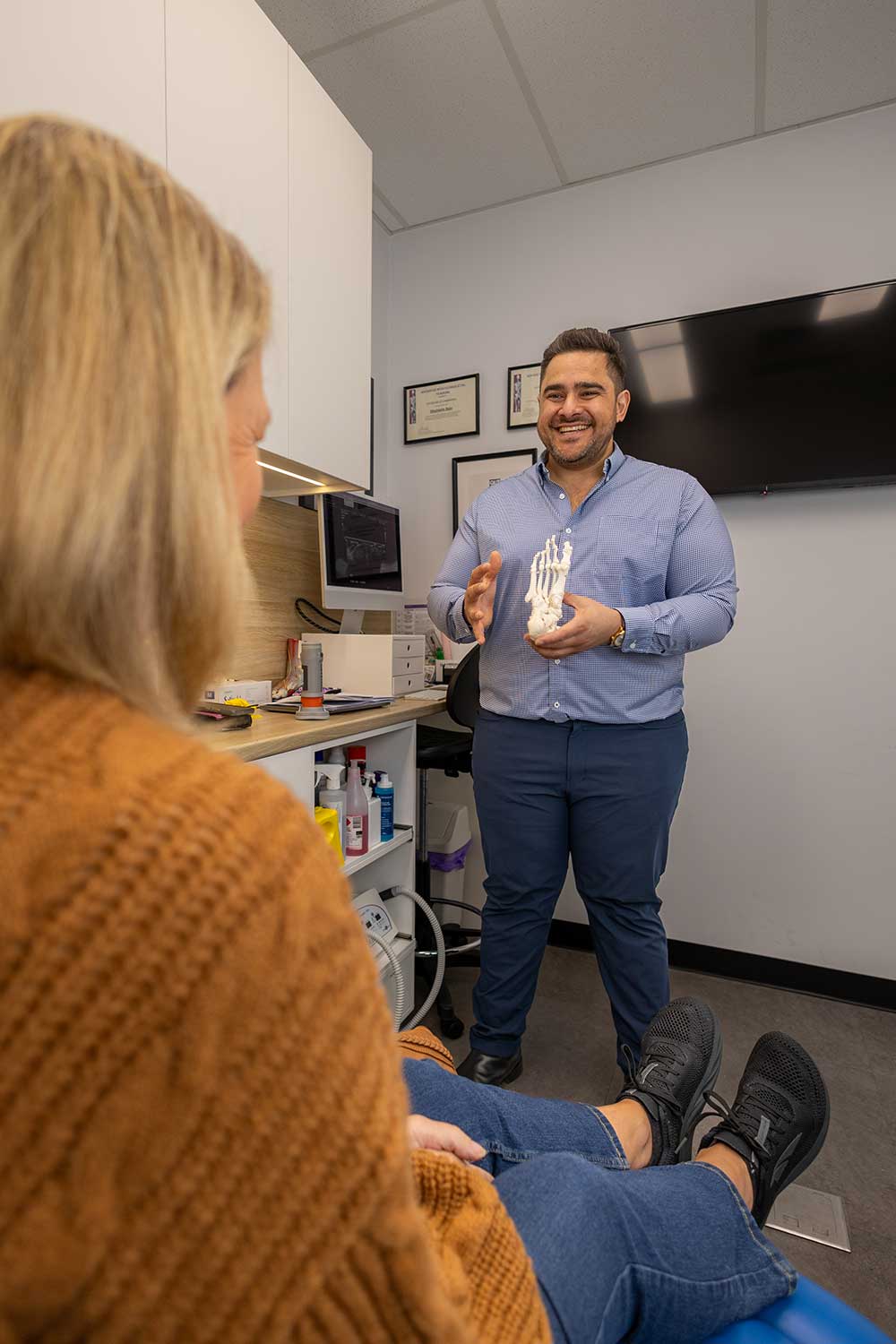
Book an Appointment for Stress Fracture Treatment in Brisbane
If you have pain in one area of your foot or lower leg that gets worse with walking, running or jumping, it is worth having it assessed. You do not need to wait until you cannot walk or an x-ray shows a crack. Our Brisbane podiatrists can assess the painful area, arrange or recommend imaging when needed and create a treatment plan based on the bone involved, your health and the activities you want to return to. Appointments are available at our Brisbane CBD and Newmarket clinics.
FAQs
How Do I Know Whether I Have a Stress Fracture or Shin Splints?
Stress fracture pain is often focused over a small area of bone. Pain commonly increases as you continue walking or running, and the same spot may be sore when pressed.
Shin splints, also called medial tibial stress syndrome, more often cause pain along a broader area of the inside edge of the shin. However, the two conditions can overlap and symptoms alone are not always enough to tell them apart. Stop painful impact exercise and arrange an assessment if the pain is becoming more localised, more intense or is affecting normal walking.
Can a Podiatrist Help with a Stress Fracture?
Yes. Podiatrists assess and manage bone stress injuries in the foot and lower leg. This can include examining the painful area, reviewing training and footwear, arranging or recommending imaging, protecting the bone, prescribing a moon boot or other offloading when appropriate and guiding a gradual return to activity.
If the injury needs medical investigation, surgery or care outside podiatry, we will refer you to the appropriate practitioner.
Can I Walk on a Stress Fracture?
It depends on the bone and the grade of injury. Some low-risk injuries allow comfortable walking in supportive footwear. Others need a boot, crutches or no weight through the foot for a period.
Pain is an important warning. If normal walking hurts or makes you limp, reduce the load and seek advice rather than trying to walk through it.
Do I Need a Moon Boot for a Stress Fracture?
Usually not, but this is case dependent. A moon boot may be useful when walking is painful or the injured bone needs more protection. Some stress fractures can be managed with activity changes and supportive footwear, while high-risk injuries may need stricter protection than a boot alone.
A boot should be prescribed for a reason and reviewed. Wearing one longer than needed can lead to stiffness and loss of strength.
How Long Does a Stress Fracture Take to Heal?
Healing the bone is also not the same as being ready for full sport. Strength and impact load usually need to be rebuilt gradually after everyday walking becomes comfortable.
What if My X-Ray Is Normal?
A normal early X-ray does not always rule out a stress fracture. Small injuries can be invisible until the bone has started healing. If the history and examination still point to a bone stress injury, your clinician may recommend MRI or another scan and protect the area in the meantime.
How Can I Reduce the Risk of Another Stress Fracture?
Prevention should focus on the factors that mattered in your case. This may include:
- building training gradually and allowing recovery between hard sessions
- eating enough to support exercise and bone repair
- addressing low vitamin D, hormonal changes or bone density concerns with the right health professional
- replacing worn footwear and taking care when changing shoe type
- improving strength and movement control where needed
- following a staged return plan instead of jumping back to your previous workload
This is something your podiatrist will absolutely consider as part of your treatment plan, and work with you to help reduce the risk of another stress fracture in the future.